
Training with Punta Lara Park Rangers Ahead of Installing ASE’s Fire Prevention System
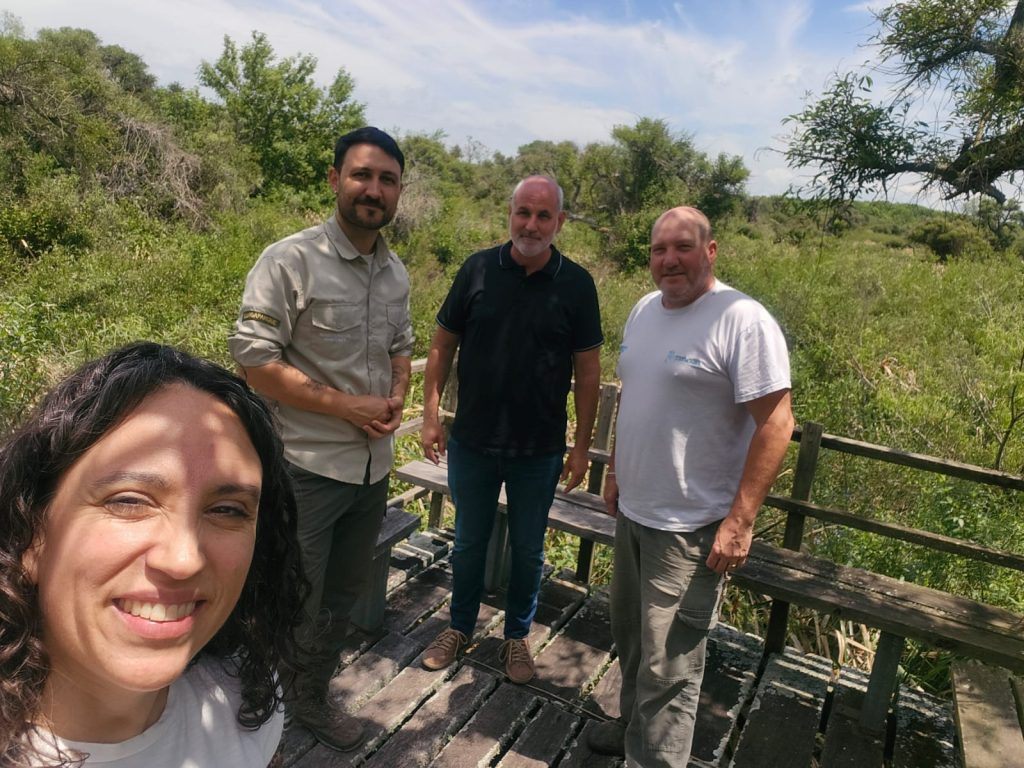
The session took place today inside the Punta Lara Nature Reserve, ahead of the installation of the Fundación Argentina ASE system. The initiative combines two complementary capabilities: infrared cameras to identify flames and smoke around the clock and warn of imminent threats, and environmental sensors whose readings make it possible to model risk scenarios and generate early warnings.
On November 16, 2026, Fundación Argentina ASE held a training session with the park rangers of the Punta Lara Nature Reserve in preparation for the installation of its forest fire prevention and detection system. Mariano Zapico, the Foundation’s Project Director, and Cecilia Pon, its Executive Director, attended the event.
The team was welcomed by the park rangers, and the training took place inside the reserve. The meeting introduced the equipment's operation and the monitoring and alert tools that will become part of the area's protection work, bringing technological capabilities together with the experience of those who know and patrol the territory every day.
Imminent detection and early warning: two complementary functions
ASE's system was designed to operate at two different stages of prevention: anticipating the conditions that create a risk scenario and identifying signs of fire that require immediate attention. This distinction shapes how its two components work and how the information they produce will be used.
The imminent-detection component uses infrared cameras to identify flames and smoke 24 hours a day and flag situations requiring prompt verification. Its function goes beyond providing landscape images: it seeks to recognize thermal signals potentially associated with the start of a fire and provide information to trigger a response. The configuration presented for Punta Lara includes two 90-degree cameras and round-the-clock monitoring.
The early-warning component, meanwhile, relies on sensors that measure environmental conditions. The weather station and carbon dioxide sensor will record temperature, humidity, atmospheric pressure, wind, precipitation and CO₂ concentration. These measurements will provide the local information base for risk analysis.
Processing these parameters together will make it possible to model risk scenarios and issue preventive alerts. The aim is not simply to know each sensor's reading, but to interpret the combination and evolution of variables to identify conditions requiring increased vigilance. Thus, while the cameras will focus on detecting a specific heat signal, analysis of environmental records will help anticipate potentially dangerous scenarios.
The two capabilities complement each other but must not be confused: an alert about risk conditions does not confirm a fire, just as a fire signal must be assessed in context. The objective is to provide distinct types of information so that those responsible for the area can verify each warning and organize the appropriate actions.
From measurements to operational decisions
To manage environmental information, the proposed setup includes a data logger responsible for receiving, recording and storing measurements. Remote access and the RIKA Cloud platform will allow users to consult records, view graphs and manage alerts. This infrastructure will provide both real-time information and historical records for comparing periods and observing trends specific to Punta Lara.
The training also addressed the transition from monitoring to operations. The next phase envisages an Action Protocol and an Operational Guide for the Pilot Test, intended to define responsibilities, the receipt and validation of alerts, communication channels and incident logging. The proposed sequence — alert, verify, communicate and record — seeks to turn each warning into an organized procedure coordinated with the park rangers' work.
This initiative builds on the cooperation agreement signed in 2024 between Fundación Argentina ASE and Argentina's National Parks Administration, which included a pilot test in Ciervo de los Pantanos National Park. The agreement linked ASE's provision, installation and maintenance of equipment with the National Parks Administration's territorial knowledge, consolidating an approach that brings technology and conservation together.
Technology serving an exceptional riverside natural heritage
The Punta Lara Nature Reserve protects approximately 6,000 hectares in the districts of Ensenada and Berazategui, under the authority of the Ministry of Environment of Buenos Aires Province. It preserves original habitats along the Río de la Plata coast: reed beds, tall-grass wetlands, lagoons, grasslands, native Celtis woodlands, forests of cockspur coral trees and native willows, and riverside forests. One of its most distinctive environments is the marginal rainforest, recognized as the southernmost in the world.
Its riverside importance also lies in the functions these ecosystems perform for the territory. Reed beds help stabilize substrates, slow water flow and trap sediment, while coastal forests help protect the floodplain from flooding caused by rain and southeasterly winds. Preserving them means protecting biodiversity and the natural processes that sustain the riverside's ecological balance.
Today's session was a step toward installing the system and placed the people who will use it at the heart of the initiative. For Fundación Argentina ASE, bringing technology into conservation means turning measurements into knowledge, risk scenarios into prevention and heat signals into timely warnings. The purpose is to improve anticipation and response times to protect an irreplaceable natural heritage.